

Stafford Beer’s notable invention of the Viable System Model (VSM) brought to life his vision of organisations as living systems, not machines.
The VSM would persevere as a relevant tool for organisations and societies confronting complexity, ecological limits, technological disruption, and crises of governance. Stafford’s model of a viable system—applied to organisations—was predicated on Ross Ashby’s concept of (requisite) variety that promotes adaptability and resilience of the system to changing operating environments.
In honour of 100 Years of Stafford Beer, The Australian National University School of Cybernetics’ Tom Chan and Thomas Biedermann collaborated with the cybernetician’s daughter, Vanilla Beer, on a card deck that both celebrates her father and the mind that impacted decades of applied systems thinking and practice.
The card deck will make its debut at the 100 Years of Stafford Beer Metaphorum taking place at the Manchester Business School 17–19 September. A tribute to Stafford’s legacy and archive has been created on the staffordbeer100.com webpage.
Stafford’s legacy#
If he had not died in 2002 at age 75, Stafford Beer — the ‘Father of Management Cybernetics ’(V. Beer and Leonard 2019)— would be 100 years old in September 2026. Such was his love for his craft, that he had carved in capital letters on his gravestone one of the most well-known quotes in cybernetics/systems thinking:
THE PURPOSE OF A SYSTEM IS WHAT IT DOES
(or ‘POSIWID’ to systems/cybernetics practitioners)
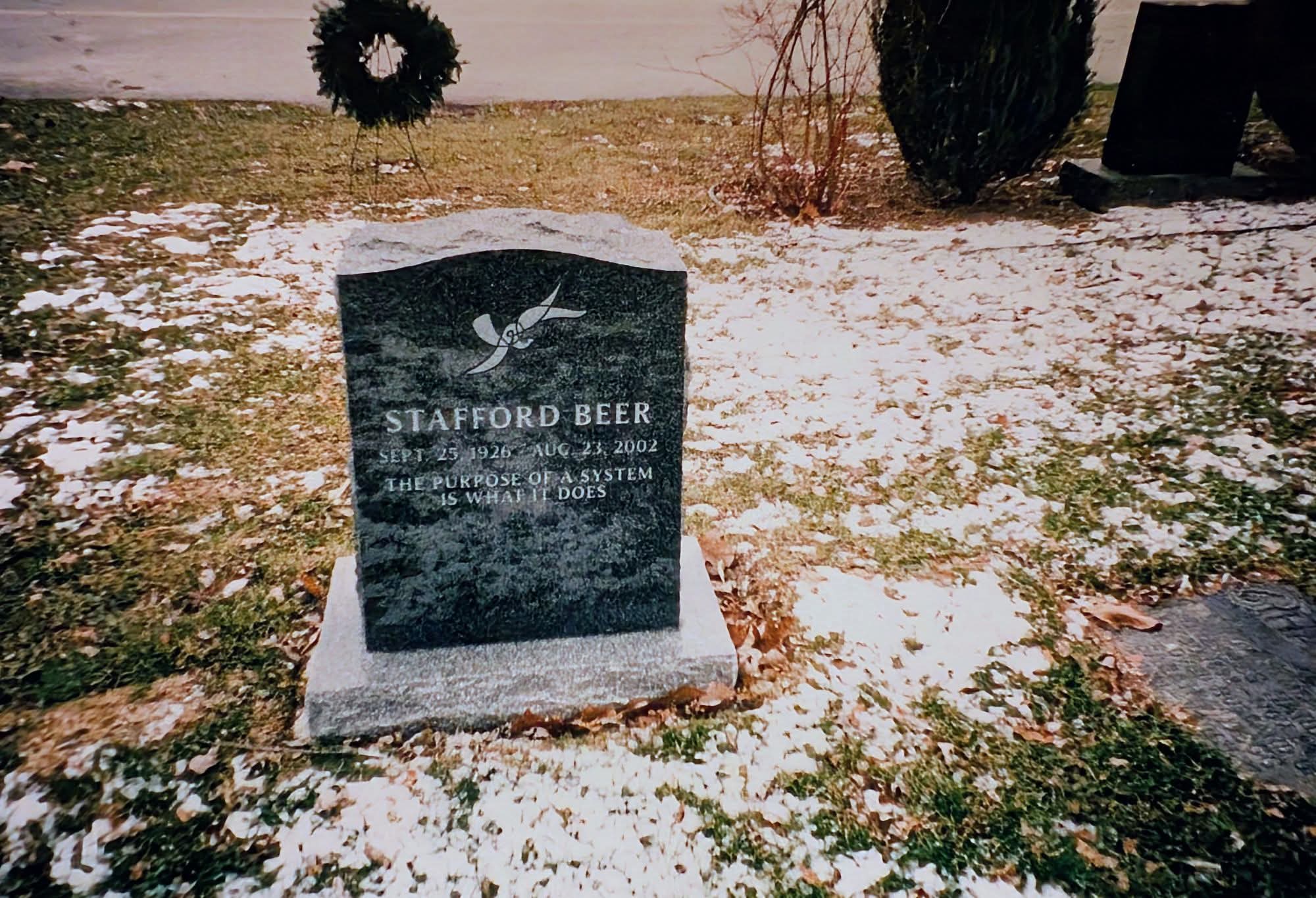
This was his pithy reminder that the vision statement on a brochure matters less than what a system actually produces, day after day.
What would Stafford say, in September 2026, if we invoked POSIWID to provoke discussions about the emerging, interconnected systems of today?#
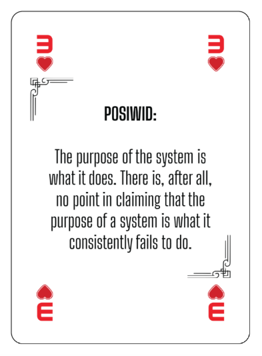
POSIWID has evolved over decades into a prompt for viable organisational diagnosis and design. POSIWID has been referred to as a practical rule of thumb in system thinking, a famous dictum in cybernetics, used ‘to explain that the observed purpose of a system is often at odds with the intentions of those who design, operate, and promote it.’ (Benjamin and Komlos 2021).
“There is, after all, no point in claiming that the purpose of a system is to do what it consistently fails to do.”
Stafford Beer, Diagnosing the System for Organisations.
This should resonate with most observers of local, national and global developments in 2025–26. Around the world there is increasing discontent and evidence of harmful impacts from widening gaps between the claimed intents of our social, economic and engineered systems, and their actual outcomes: from systems of international trade and cooperation, to institutions protecting human dignity and property rights, to governance regimes designed to engender trust in elected governments and for corporations to act safely, sustainably and responsibly in the interests of society and the planet.
“The more we learn about control systems in nature… the more we begin to understand how the organism learns from its own experience, seeks and finds a goal, settles down again after being disturbed, adapts to different stimuli, and evolves to meet changing circumstances.”
Stafford Beer, What Did Stafford Say card deck.
In this context, designers and stakeholders of systems affecting behavioural change could choose to invoke POSIWID to cut through the fog of stated intents and moral judgments to bring the focus and conversations back to real-world impacts. POSIWID could challenge businesses, policy makers and regulators to treat unintended consequences as system outputs.
Today, many timeless quotes from cybernetics are familiar to few outside the relatively niche communities of expert systems thinkers and practitioners: ‘specialist-generalists’ in a world of ‘specialist-specialists’. Quotes such as POSIWID ought to be a clarion call in 2026 for everyone affected by the rapid AI transition to pause; filter out distracting hyper-marketed signals of intent; and reframe/reconsider actual systemic effects as features and not bugs of systems.
In 2026, POSIWID could be a handy systems-thinking ‘wild card’ playable by anybody—citizen, worker, consumer, producer—engaged in conversations about our current socio-technical transition trajectory along the lines of ‘AI everything. AI it fast’.
Playing the POSIWID card*#
*Limited edition first print/prototype!
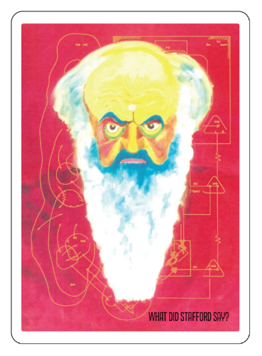
Designed by Thomas Biedermann, derived from Stafford Beer's self portrait.
The genesis of the What did Stafford Say? playing cards dates back to 2023 when Tom Chan invited Vanilla to be a guest on the ANU School of Cybernetics’ Cybernetics Snacks speaker series. They quickly became good mates. It became an inside joke for Tom to routinely ask Vanilla “What would Stafford say?” on a wide variety of topics, something he didn’t stop doing when he visited Vanilla in 2024. More yarns between the two sparked what would become Vanilla’s endeavour to compile quotes from Stafford’s writings, both intellectual and personal, for publication ahead of his centenary year. Meanwhile, Tom was imagining novel and creative ways to represent Beer’s ideas, the VSM, and engage management cybernetics in more interactive and embodied ways. He sought the help, expertise and inspiration of Thomas Biedermann to collaborate on the design of some Stafford Beer cards.
As the two Toms iterated designs, Vanilla published her book ‘What did Stafford say?’.
“Authentic quotes, selected by his daughter. One for consideration each week of the year.”
Vanilla Beer 2026
Fifty-two unique quotes? The same number of suited cards in a standard playing deck! The alignment was (cybernetically) serendipitous.
The humble 52-card deck is an emblematic archetype of a high-variety system that has proven its viability over time and in numerous contexts. Thousands of single/multiplayer games can be played on the ubiquitous deck, and 52 cards can be shuffled/arranged in more ways than the estimated number of atoms on Earth.
Beyond the 2130 words printed across the 52 cards, the deck also features meaningful pictures. On the back of the cards is ‘Shakta: Self-Portrait’ 1981 painted by Stafford Beer himself (from the Stafford Beer painting archive https://staffordbeer100.com/museum; https://staffordbeer100.com/museum/paintings/large/shakta-self-portrait.webp ). The iconic VSM diagram and the Team Syntegrity icosahedron (or 20-sided dice) are used for the 2 extra non-suited ‘joker’ cards.
Over the next months, we will invite the recipients of the decks to share how and where they used the cards; testimonials and visuals of the deck travelling around the world. Watch this space or play along, to shape, ultimately, the purpose of this system.