
Making the leap from Engineer to Cyberneticist, and back again (and again).
Amir Asadi’s background in engineering led him to interesting and tricky challenges to unpack in the healthcare sector, it wasn’t until he saw the Master of Applied cybernetics program that Amir explored how technology can be better developed for the complexity of the healthcare system, particularly in an age of emerging technologies.
What inspired you to begin a PhD?#
My background is in engineering, in developing technologies for healthcare systems. Much of my work here pre-PhD was in developing an exoskeleton robot that helped people with spinal cord injuries to walk again.
This was a challenging project, not just because I was developing a new complex piece of technology, but mainly due to the challenges of integrating new technologies with the existing healthcare system. There were matters of the trust and rapport needed with patients and physiotherapists, limitations of physical space and time for the robot, alongside many other systems problems.
I realised that studying and training to become an engineer hadn’t prepared me for these challenges and so I began looking for an education opportunity that would give me the necessary skills to anticipate and prepare for these challenges.
When Amir saw the Master of Applied Cybernetics program, he says it all clicked for him, that this could be a way to become more familiar with these problems that were blocking his engineering work.
Six years later, this was the context Amir finished his PhD in.

What is your PhD titled and what did it explore?#
My PhD is titled Human-Robot Collaboration for Healthcare: Socio-Technical Insights on Development and Implementation. My work looks into the development and integration of human-robot collaboration in healthcare settings, focusing on contexts where AI-enabled robots work alongside healthcare professionals in shared spaces, toward shared goals, and within existing clinical workflows.
Throughout my research I looked at how robots designed to assist with healthcare, such as physiotherapy assistance robots, actually integrate and interact with the health care system. More specifically, I look at helping both developers and people who work on integration and implementation of human-robot collaboration in healthcare settings be better prepared for the unique contextual challenges in this space.
Amir’s research looks into the invisible and unspoken constraints and challenges of working within technological and healthcare systems, dealing with the very conundrums that Amir was encountering as an engineer – but now looking at them through a new lens.
Using approaches aligned with cybernetics, such as systems thinking and socio-technical systems theory, Amir’s research highlights what non-technical factors should be involved in decision-making for robots and AI-enabled systems in healthcare, using this to build a framework to more efficiently design systems.
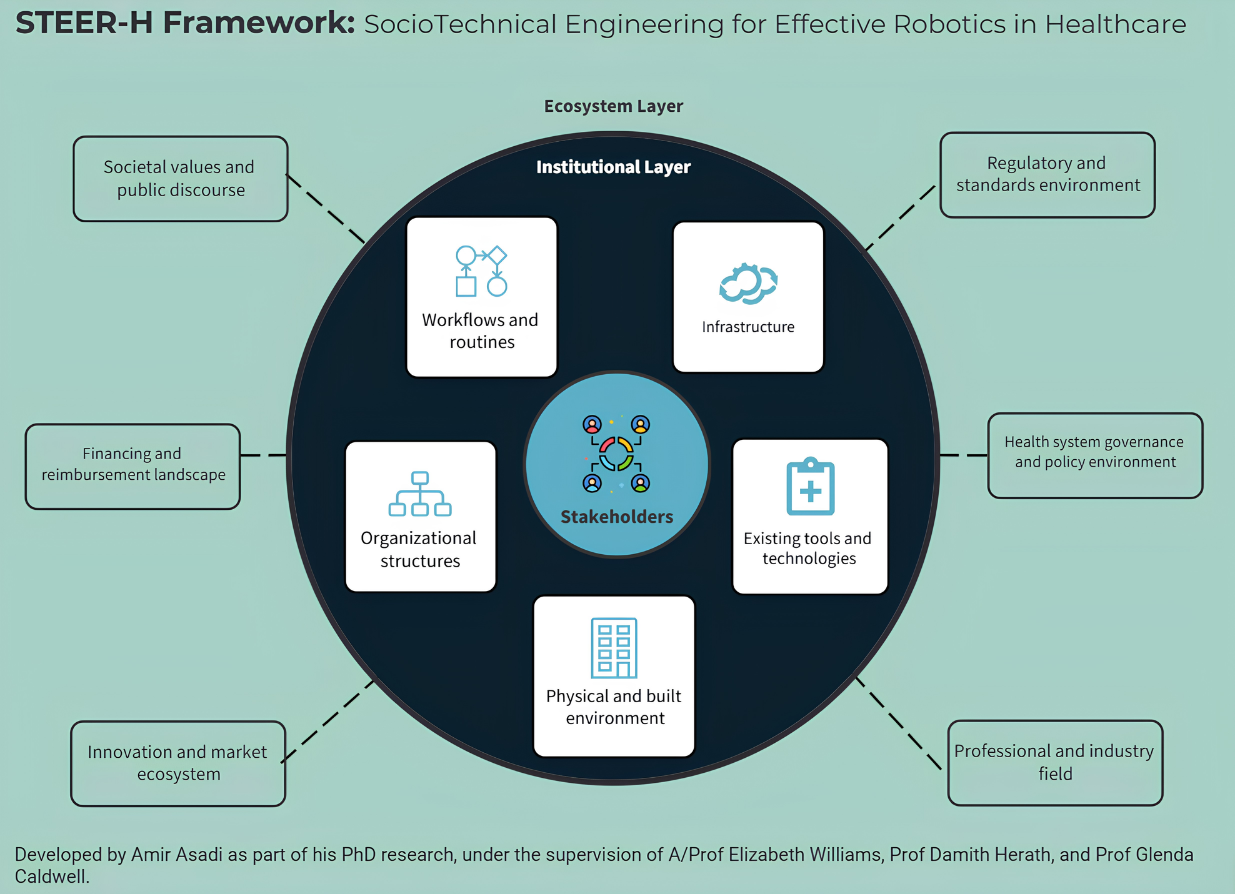
The goal of Amir’s research is to support engineers, designers, and developers of robotics and AI-enabled healthcare technologies to better anticipate the challenges of working within complex healthcare environments, and to design systems that are more responsive to those contexts. To do this, he developed a sociotechnical framework called Sociotechnical Engineering for Effective Robotics in Healthcare (STEER-H), which identifies three interacting layers shaping the integration of human–robot collaboration in healthcare. The framework highlights three interacting layers: stakeholders who engage with or are affected by the technology, institutional conditions that shape how it fits into healthcare settings, and broader ecosystem forces that influence its development, adoption, and long-term sustainability.
The name STEER-H also carries a deliberate nod to cybernetics, where “steering” refers to guiding systems through feedback, adaptation, and change.
Tell us more about your research#
To conduct this research, I first spoke to experts in the field, including people who developed robots for healthcare, the people who use these robotic systems (such as healthcare professionals and practitioners), and the people who regulate these healthcare and robotic environments. I complemented this with a quantitative study to support the stakeholder level, including a focus on acceptance factors like performance expectancy, trust, and risks.
One of the case studies where a hospital used a rehabilitation robot for patients, demonstrates the unintended consequences and flow on impacts of these technologies and their complexities. Whilst this robot had a positive impact on the patients who were using it for rehabilitation, it also required staffing to an extent that the patients who were not using the robot were getting less therapy time with the staff.
My work really showcases that hospitals and healthcare settings are hard to work with because they are they are complex sociotechnical environments, where technologies must fit within existing workflows, professional roles, safety requirements, organisational cultures, and patient-care priorities. Sometimes the biggest barriers aren’t technical, but social, organisational, and contextual: how people trust, adopt, adapt to, and work with new technologies in practice.

How has the school’s approach to Cybernetics, systems and futures shaped or guided you as a researcher?#
Cybernetics is a nice complementary skill that allows me to think about how systems come together, how one specific element of a system works within the other, and reminds me of contextual factors. Cybernetics is a neat way for me to expand my engineering skills and engineering mindset.
The hardest part of my transition in moving to the Cybernetic research space was shifting my way of thinking, moving between an ‘engineering’ and a ‘cybernetic’ mindset.
Typically with an engineering problem, you’re focused on one area or specific part of the problem, and usually this problem is both tangible and easy to measure. But when you move to a more cybernetic mindset you expand to think about interconnectedness, feedback loops, and a bigger systems-view.
This is something I still find challenging now, but being able to switch between both an engineering and a cybernetics mindset is incredibly helpful in my current role.

What’s next for you? How will you apply your talents and skills?#
Originally, I chose this topic to work on because it was a challenge that I did not have any clear ideas on how to solve. Also, with the safety-critical nature of the setting I felt that my work here could help lift a barrier of healthcare systems working efficiently.
Ultimately, I want to create an awareness for technology developers of what a safe and responsible way of designing for healthcare systems looks like.
Following my PhD I return to working as a technology developer for healthcare settings, there is crucial and systematic work to be done here.
At heart, I am a techno-optimist I feel there should be a safe and responsible way to help improve healthcare systems through more efficient and fit-for-purpose technological developments.
Amir’s research:#
- Redrawing Boundaries: Systemic Impacts of Rehabilitation Robots in Clinical Care Settings
- Preparing for change: Reflections on technology design research in real-world healthcare contexts
- Acceptance of Human-Robot Collaboration in Hospitals: Trust, Risk, and Ethics in Focus