
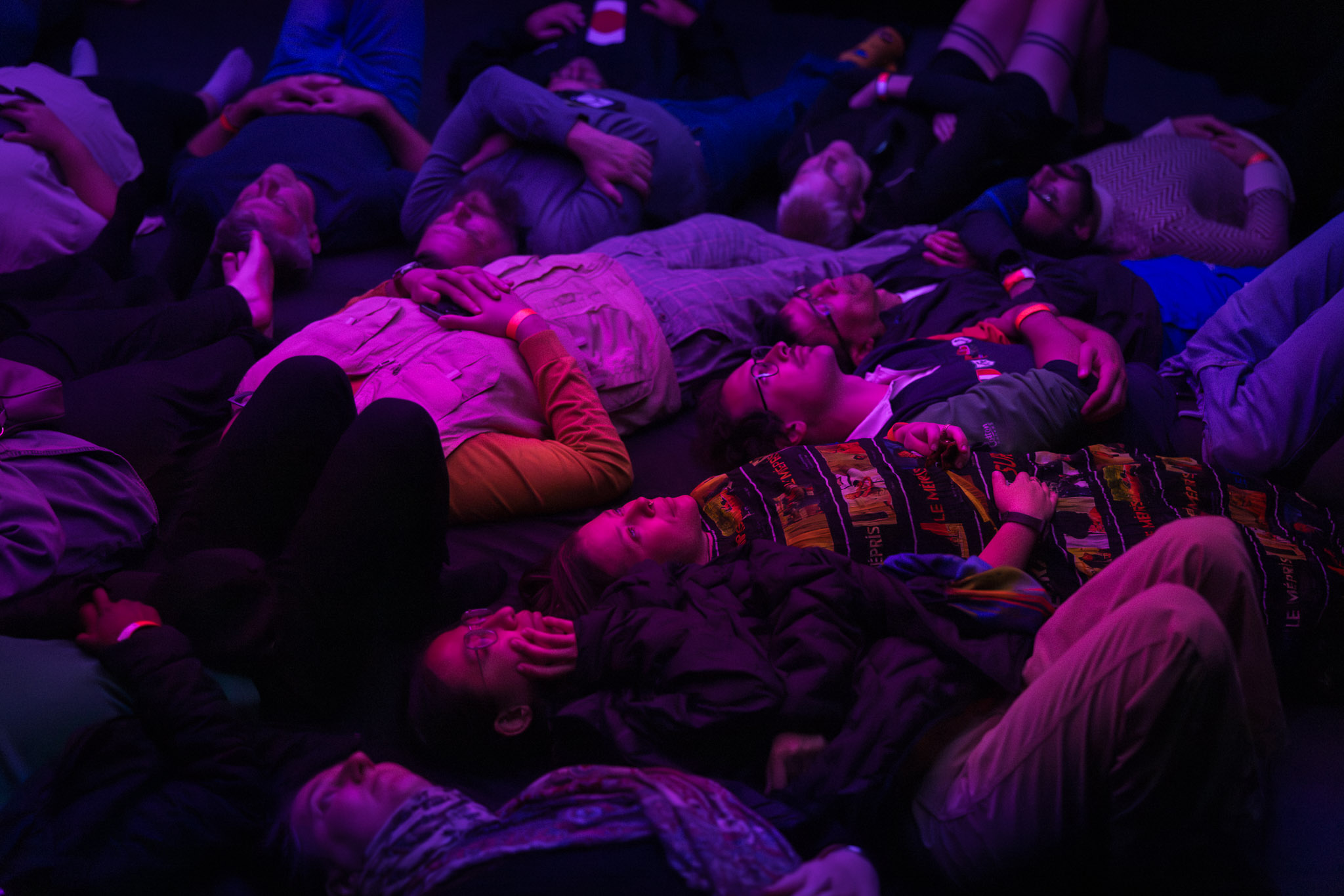
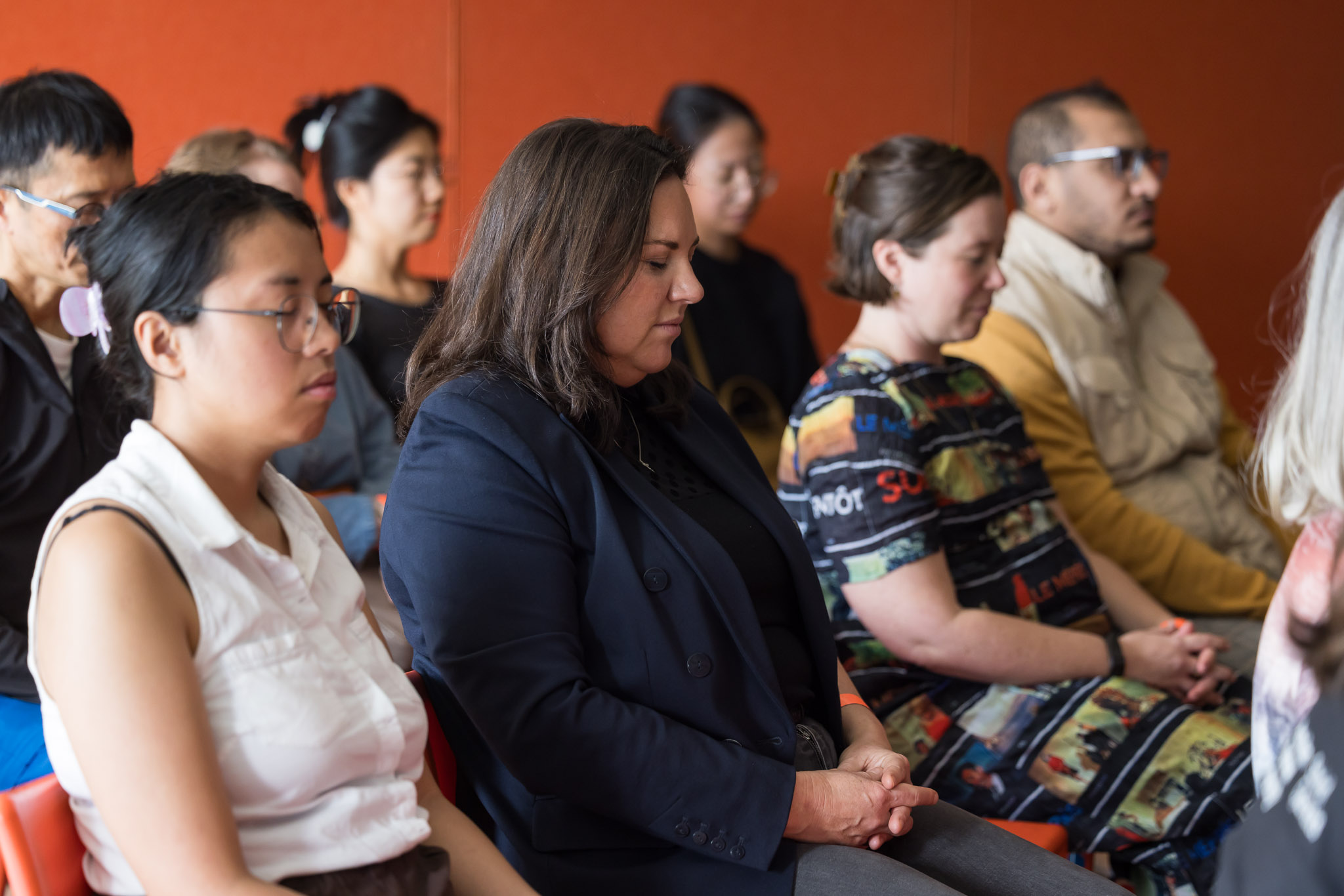
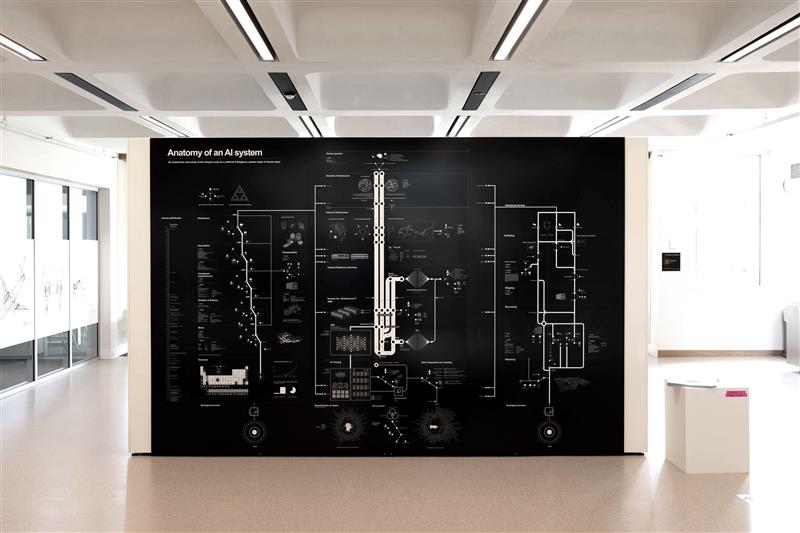
On 24 April 2026, the School of Cybernetics organised a trip to Sydney for a collective College visit to the Museum of Contemporary Arts for the exhibition, Data Dreams: Art and AI. It featured mesmerising works by visionary artists, including our colleague Angie Abdilla’s Meditation on Country and our former resident Kate Crawford’s Anatomy of an AI System, created in collaboration with Vladan Joler. The visit offered many of us pensive moments to think deeply about our relations with data, systems, algorithms, art, and something that cuts cross all those elements, artificial intelligence.
Angie’s Meditation on Country interweaves the cosmic evolution with Ancestral time through a creation story shared across western astrophysics and Indigenous knowledge systems. Once we laid ourselves onto the padded ground within the exhibit, we were welcomed by the calming voice of Yuwaaliyaay Elder, Uncle Ghillar Michael Anderson, who recounts oral histories of Baiame — the revered creator god and Sky Father in the Dreaming stories of several Indigenous nations across south-eastern Australia. Afterwards, gentle chanting of an Indigenous song followed, and then a suite of imagery unfolded before us, each sequence manifesting stories of creation and evolution.
There was an intense flash of light representing the Big Bang, followed by supernova explosions giving rise to galaxies, planets, and eventually life itself. Among the visualisations were Conway’s Game of Life, evoking two-dimensional retro video games (called Galaga in my childhood), and Lenia, a continuous cellular automata model generating colourful animated mathematical “lifeforms.” Meditation on Country concluded with evolutionary imagery of birds morphing from one form into another.
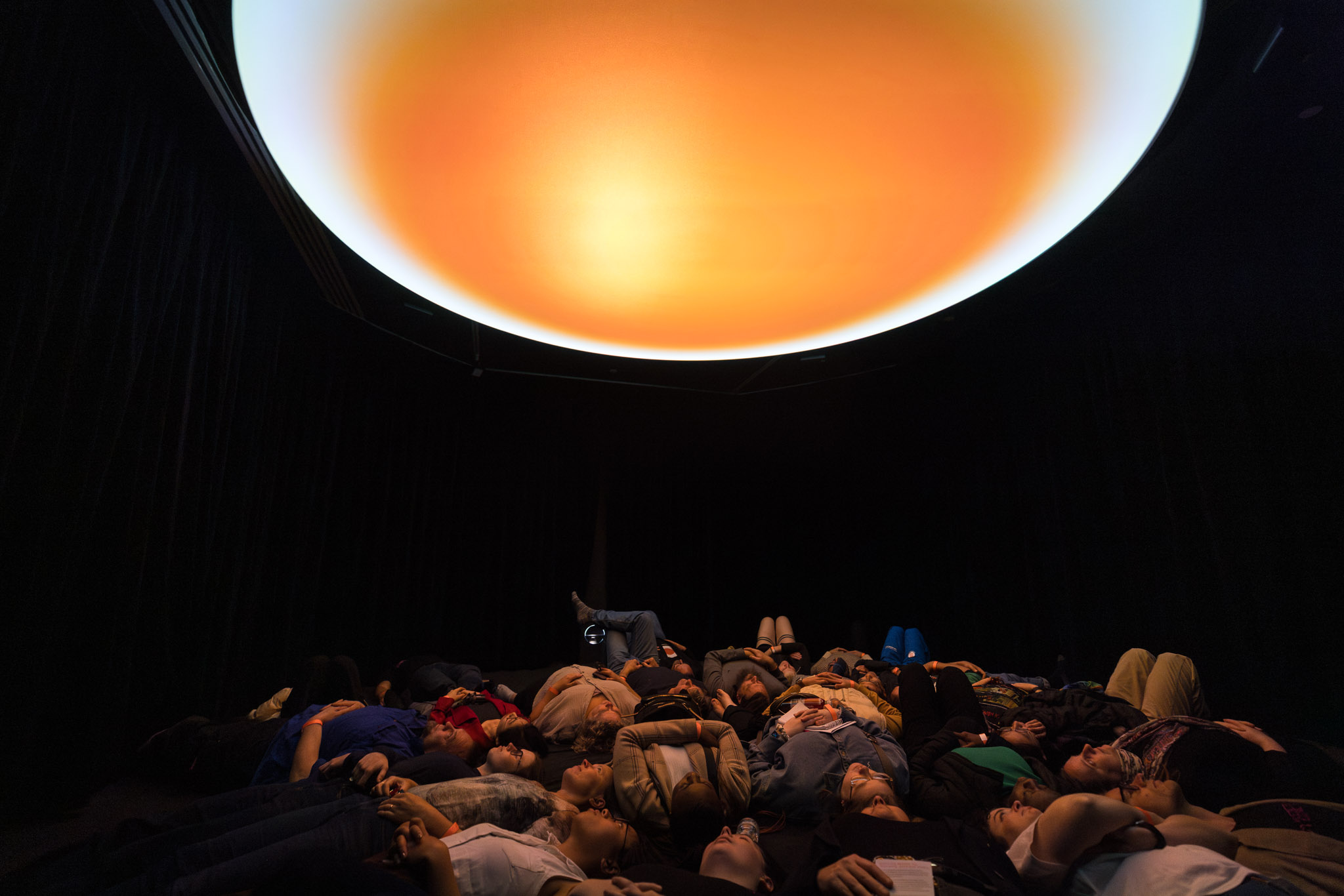
What Meditation on Country presents is not merely a simulation of the beginnings of the universe, life, and story, but also a meditation on how such stories are carried, generated, and related across worlds. The work is enabled through data, algorithms, machine learning, and computational simulation, yet it continually beckons to something that exceeds technical representation alone: relationships between people, Country, memory, cosmology, and lived experience. In this sense, the work quietly raises a profound question: What does it actually mean to “know,” “generate,” or “participate” in a world?
Below are a few threads of thought for those who had the chance to visit the exhibition to find something resonant within my words reflective of your own experience. For those who couldn’t make it, I hope these reflections still connect with, or weave into, your own experiences.
1. Relationality#
We humans are social animals — we are hardwired for connection, forging deep, meaningful relationships with people and things around us. We explore the world around us along the course of time, building our own perspectives to understand and act on what we face. Our experiences can be enriched through encounters with serendipity that are not necessarily, or strictly, correlated with our motives, yet resonate deeply within our hearts. Along with such serendipitous opportunities, human experiences — and the consequential actions or decisions thereafter — are all interconnected
We can never fully comprehend one without its relations to others.
Unlike us, AI is trained on millions of data points. Drawing upon such vast quantities of data, AI is remarkably effective at identifying patterns, classifying information, and reorganising or synthesising it to achieve goals specified by human users. This is crucially different from how we perceive the world through “experiential data,” which entail causality and internal drives shaped by each individual’s past trajectories, while also being bounded by the temporal and embodied nature of human cognition. I am generally hopeful about AI’s capabilities (guided by the goodness of humanity), yet I believe we cannot ignore the fact that AI lacks relationality in the sense that it does not “live” the world. Rather, it encounters relationality only through patterns encoded in data. How could one ever know what it means to care, remember, hesitate, regret, rebound or belong without experiencing bittersweet moments that emerge through our journeys across space and time?
This point becomes particularly interesting in my work on analysing output sequences produced by generative AI models. When we play telephone (or the whisper game), we relate an input to an output through our own worldview, that is, through interpretation. Generative AI models can act similarly to this game of telephone. However, what seems to be missing from these models is that, for us humans, interpretation is not merely a mapping between input and output. Instead, we situate them within a web of lived relations — intentions, histories, and consequences that extend beyond the immediate act of generation: A single word may evoke a childhood memory, a story may be interpreted differently depending on one’s cultural background, or a message may acquire new meaning because of a relationship with the person who shared it. And of course, there is always a non-zero chance that one of the participants in the telephone game deliberately changes the course of information transmission with the simple, mischievous intention of making the game more entertaining! (I didn’t say it was me!)
If we think carefully about how generative AI works, it operates primarily through statistical associations across data, without an intrinsic sense of why a relation matters, or how it is embedded within a broader trajectory of experience. From a cybernetic perspective, the difference in relationality also points to a difference between systems that process signals and those that are recursively shaped by their own participation in a world.
In this aspect,
AI can reproduce patterns of relationality but does not itself participate in them.
It relates within data, but not through a lived world. This distinction, albeit subtle, raises questions about whether outputs that appear coherent and contextually appropriate truly carry the depth of relational meaning that human experiences entail. Perhaps what Meditation on Country foregrounds is that creation is not merely the production of outputs, but an ongoing act of relational participation in the world.
2. Entanglement#
Many of us may be experiencing a growing tension in separating ourselves from AI. As its capabilities continue to improve, AI increasingly accompanies us in our everyday activities in ways that are becoming difficult to ignore. It can tidy up messy computers that we have neglected for years due to other commitments; it can generate an entire holiday itinerary within a budget and tailored to our preferences, which might otherwise have been a nightmare to organise on our own; it can even offer us helpful advice on everything from DIY repairs to human relationships. What is striking is not simply that AI is becoming more capable, but that it is becoming increasingly woven into the fabric of our everyday lives. The feeling that AI is increasingly close to our daily life is getting harder to shake.
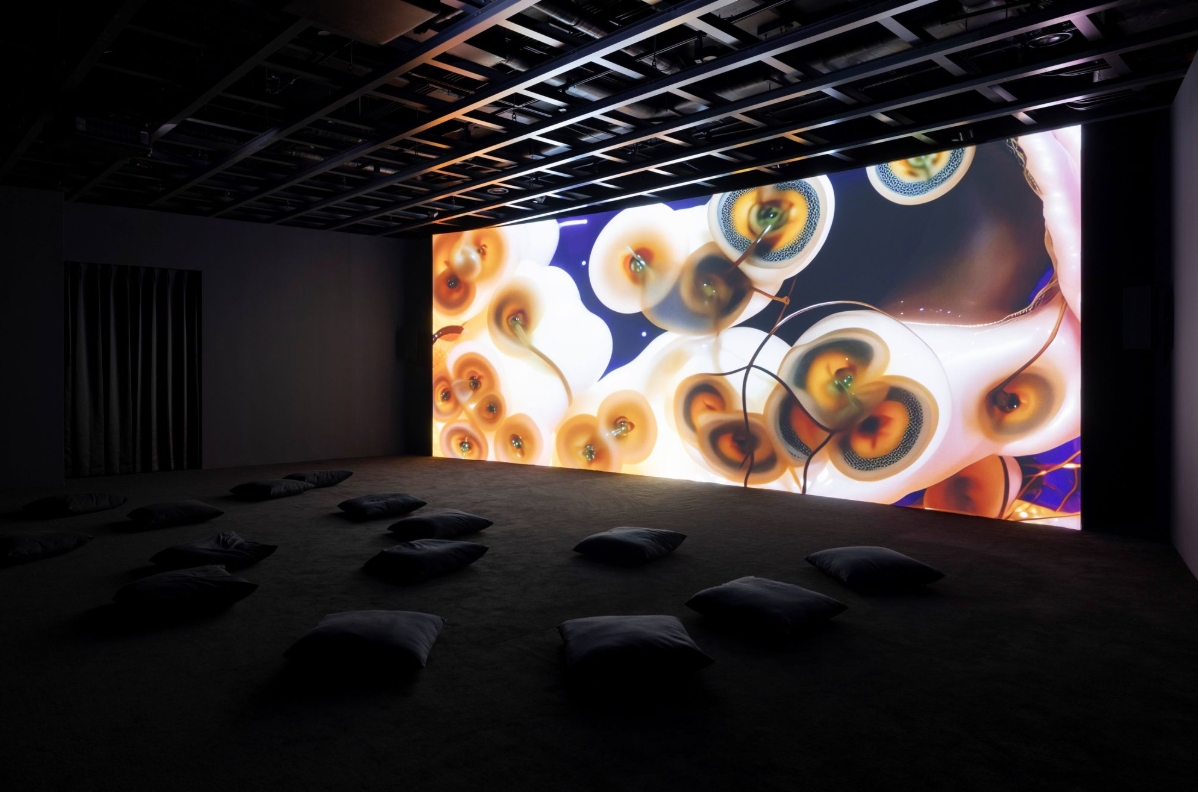
When I walked into a dark room with a big screen for Each Branch of Coral Holds Up the Light of the Moon, a film of AI-generated creature-like beings by Anicka Yi at the exhibition, I was struck by the vagueness of the boundary between human-made artefacts and AI-generated outputs. I might well have believed it if someone had whispered in my ear that those sleek, moist, organism-like beings can be found from the deep ocean. However, if we take a pause to look closely enough, it is still possible to detect “AI-ness” in such generated material — sometimes through contextual cues (e.g., too good, too odd, or too inconsistent to be true) or simple irregularities (e.g., defying physics or biology), and many other subtle signs that our intuitions seem to pick up almost instinctively.
There is perhaps a certain irony in this. One of the strengths often attributed to AI is its remarkable ability to recognise patterns across vast amounts of data, but we humans seem equally adept at recognising patterns through embodied experience. Even when we struggle to articulate what feels unusual, our intuitions often detect subtle departures from the patterns of the world that we have come to know through participation in it.
Hence, the difference may not lie in recognising patterns itself, but in the kinds of worlds from which those patterns emerge.
After drifting through speculative futures and synthetic lifeforms, Crawford and Joler’s Anatomy of an AI System brought my attention firmly back to the earth. This artwork offered a rather different perspective on AI. Instead of presenting AI as something abstract or immaterial, the work revealed the enormous network of extraction, labour, energy consumption, logistics, data infrastructures, and planetary resources underlying what we casually call “artificial intelligence.” What appears to us as a seamless technological system is, in fact, deeply entangled with human bodies, social systems, ecological processes, and geopolitical structures.
In this sense, the boundary between “human” and “AI” becomes increasingly difficult to isolate cleanly. AI depends on data generated from human activity, infrastructures built through human labour, and resources extracted from the Earth, while humans simultaneously adapt themselves around AI systems in everyday life — cognitively, socially, economically, and culturally. The relation is no longer external, as if humans and AI were two separate entities merely interacting from a distance. Rather, they increasingly participate in shaping one another:
We are shaping these systems, while these systems recursively shape the conditions through which we think, create, communicate, and organise the world.
As long as “artificial” intelligence has come into existence — evolving over time like many other worldly entities — it participates in the broader ecology of human and non-human systems.
The boundaries are therefore not simply disappearing, but becoming increasingly porous, relational, and dynamic.
In this sense, the relation between AI and humans is not incidental, but constitutive. Thereby the question is, perhaps, no longer where the boundary between humans and AI lies, but how we learn to navigate the increasingly dense web of relations that binds them together.
3. Alienation#
Yet at the same time, it was interesting to observe that AI-generated outputs (whether texts, images, or sounds) evoke in me a sense of foreignness or alienation (an “AI-ness”) despite my awareness of the increasingly blurred boundaries between human activity and AI-mediated generation.
What makes this feeling particularly intriguing is that the alienation does not arise from complete unfamiliarity. In fact, many AI-generated artefacts appear remarkably familiar to us. They imitate human language, visual aesthetics, patterns of reasoning, and even emotional tones. Yet somewhere within this familiarity, subtle distortions, absences, or inconsistencies become noticeable. Something feels slightly displaced, flattened, over-compressed, or detached from lived experience. This may be why AI-generated outputs can sometimes feel uncanny — not because they are entirely non-human, but because they resemble fragments of humanity without fully participating in the conditions from which human experiences arise.
For me, the persistence of boundaries between humans and AI evokes a sense of separation (human vs AI), while the growing entanglement of AI within our lives simultaneously produces a strange sense of amalgamation (human & AI). These two tendencies occur simultaneously, just like life emerges at the edge of chaos and order, creativity springs from the interplay of divergent and convergent thinking, and stability in complex systems arises from the tension between robustness and fragility.
In some sense, this tension itself may be inevitable whenever humans encounter systems that increasingly mirror aspects of cognition, communication, and creativity. The more AI becomes embedded within our cultural and intellectual lives, the more difficult it becomes to determine where human expression ends and algorithmic mediation begins. Yet perhaps it is precisely within this ambiguity that feelings of alienation emerge most strongly:
Not from absolute separation, but from partial resemblance without shared embodiment, memory, mortality, or participation in a lived world.
Concluding…#
All the reflections above resonate strongly with my research interest in complexity, which gestures toward a kind of universality across systems and domains. Across the exhibition, I was particularly impressed by how the artworks explored tensions and interconnections between seemingly distinct realms — human and machine, story and data, cosmology and computation, ancestry and futurity. Rather than presenting these as oppositions to be resolved, many of the works allowed them to coexist in dynamic and often ambiguous ways.
What I found especially admirable was how these ideas of relationality, entanglement, and alienation were communicated through visuals, sounds, narratives, and immersive experiences that invited participation and reflection beyond purely intellectual interpretation. In doing so, Data Dreams: Art and AI revealed subtle forms of interplay that are often difficult to articulate directly, yet nonetheless, shape the sphere of our lives in profound ways. This may also be where art, complexity, and AI unexpectedly converge: not in offering definitive answers, but in making visible and sensible the relational processes through which meaning, perception, and existence continually emerge.
There is no way for me to know how AI would react to the exhibition if it were somehow able to wander through the museum. My own reaction, however, is one of gratitude. I am grateful for the opportunity to connect the moment in which I encountered these works, sharing a Friday afternoon with colleagues and students from the College, with the moment in which I now find myself writing these reflections. Perhaps this, too, is a form of relationality: weaving together experiences across space and time to create new meanings that neither moment could have produced alone.
As I left the exhibition and later returned to it through writing, I found myself less concerned with what AI can become and more attentive to what it reveals about ourselves. Through reflections on relationality, entanglement, and alienation, I was repeatedly drawn back to aspects of human existence that are easy to take for granted: our capacity to participate in a world, to form meaningful relations, to carry memories across time, and to create meanings through our encounters with others. In the spaces between relation and pattern, entanglement and separation, familiarity and alienation, I am reminded that there is always something more-to-human.