
What do researchers across far-right politics, artificial intelligence (AI), reproductive ethics, social media in warzones and gambling have in common? The ABC Top 5 Experience!
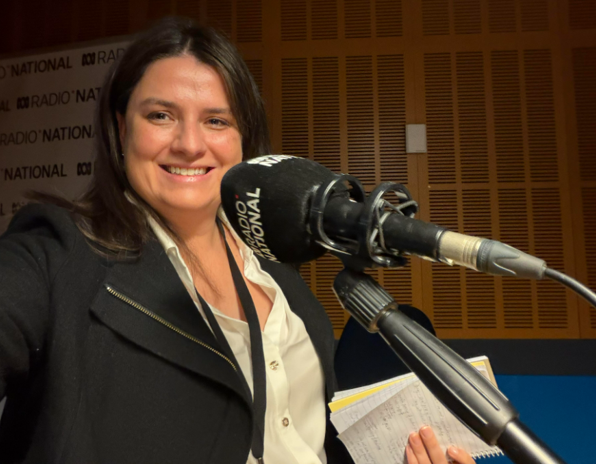
In July 2025, I spent two weeks at the Australian Broadcasting Corporation (ABC) in Sydney as part of the ABC Top 5 emerging research voices.

It’s hard to put into words the value of two weeks. Each day we met in ABC Ultimo and learned from people who absolutely loved their jobs – ABC producers, presenters, audio technicians, marketing, legal and other internal professions. They interviewed us, gave us feedback, helped us make interview scripts, explainer reels and compelling pitches and showed us how radio is created and managed.
We met Chair of ABC Kim Williams, and President of the Australian Academy of Humanities Stephen Garton and all of us were paired with mentors from the ABC – in my case, with Jessie Kay and Rae Johnston, producer and presenter respectively of the Download This Show. I helped design the episode (Nearly) everything that happened in AI this week episode and was recently a guest on Could your AI agent end humanity?.
Reflecting on the program, I wanted to share three things that have stuck with me.
Using your voice for radio is like guiding a rockclimber#
Compared to TV or an in-person presentation, voice takes on a different level of importance in radio. We heard a lot about how radio and podcasting are more ‘intimate’ than other media – in many cases, you are literally inside someone’s ears! And telling a story just with voice is an artform. We had great sessions on working with our voices with the amazing Rohan Barwick and Lindy Burns. We discussed voice preparation practices and experimented with using pauses, different speeds and being intentional with emphasis and articulation.
As we did this, I kept visualising our voices guiding a rockclimber up a climbing wall. Our research is like the wall, and we are providing the footholds and handgrips for others to traverse the landscape of our research in a way that is aligned to them – their strengths, their experience with the wall and ensuring that they remain motivated and enthusiastic to stay tuned-in throughout.
In making radio, you need to think about where the audience can put their hands and feet to catch a breath, process what’s going on, insert themselves into the story and be ready to move on to the next part of the story.

Why should they care?#
After a decade in consulting, I was very familiar with this style of question, put more abruptly in that world as “So what!?”. We came back to this time and time again, with a relentless focus on who ‘they’ are and their cares.
As researchers, sometimes we can get so deep into our topics that we believe everyone should care because it’s important. But ‘because it’s important’ is not a compelling enough reason for people to care. Instead, it needs to tap into something else, for example; it’s a unique story, it’s directly addressing a need or a selfish endeavour, or it features some amazing talent that the audience is intrigued by.
There are lots of ways that you can get people to care about our research. For example, connecting our research with:
- mystery – feeling like a conspiracy theorist uncovering something new and fascinating
- something timely and relevant, e.g. a news event, a historical date, a cultural event etc.
- passionate, infectious energy when sharing the story
- speaking in everyday language
- something practical.
Speaking specifically to the last bullet point, of connecting our research with something practical, I loved one of the exercises that Rohan got us to do: walk around for 10 mins observing what’s around, and connect our research to something that you see (in my case an air conditioner!). It’s something that I will continue to practice as I experiment with ‘ways in’ to my research topic.

Restrictions are your friend#
Structural restrictions when pitching a story, word restrictions and restrictions emanating from the ABC editorial policies were all discussed as ‘friends’.
First, how stories are pitched within the media does turn the academic writing paradigm on its head and initially felt a bit restrictive. Here’s a pitch structure that we spoke about:
- the Hook: one sentence to grab an audience. What would make me click on the episode? What will make me not turn away?
- the Heart: why should they care? Why is it a compelling story?
- the How: Who are you going to talk to? What will the story look/sound like? Where might it go across the ABC?
Leading with a hook was the most challenging part for me. It’s not necessarily a place where academics start. It is a real skill to leave nuances aside and find hooks that are simple to digest (often ‘seemingly obvious’), that resonate and that are only one sentence!

Second, we had a robust discussion about the ABC editorial policies. Similar to Responsible AI principles and policies, essentially these are the standards by which the ABC holds itself to account, examples being independence, integrity and responsibility, impartiality and diversity of perspectives. While for some journalists these policies can feel restrictive, we discussed how they can also be a way journalists feel free – free to use the policies as a way of ‘doing the right thing’ when an easier, less responsible route also exists.
Third, we did a bunch of ‘essence exercises’. One of these exercises had us sharing what we did the previous night in 16 words. Then eight. Then four. Doing this exercise showed us what we really valued in what we were sharing, how we would distil it and distil it again, and how superfluous some words really are. It was also a learning moment in understanding how others may make these choices on your behalf and may choose differently!
Four words to describe the experience: Eye-opening. Immersive. Growth. Practical.#
Four words to describe radio: Creating footholds and handgrips.#
All in all, I felt incredibly lucky to be part of the ABC Top5 and would recommend it to early-career scholars hoping to have a real-world impact with their research!
