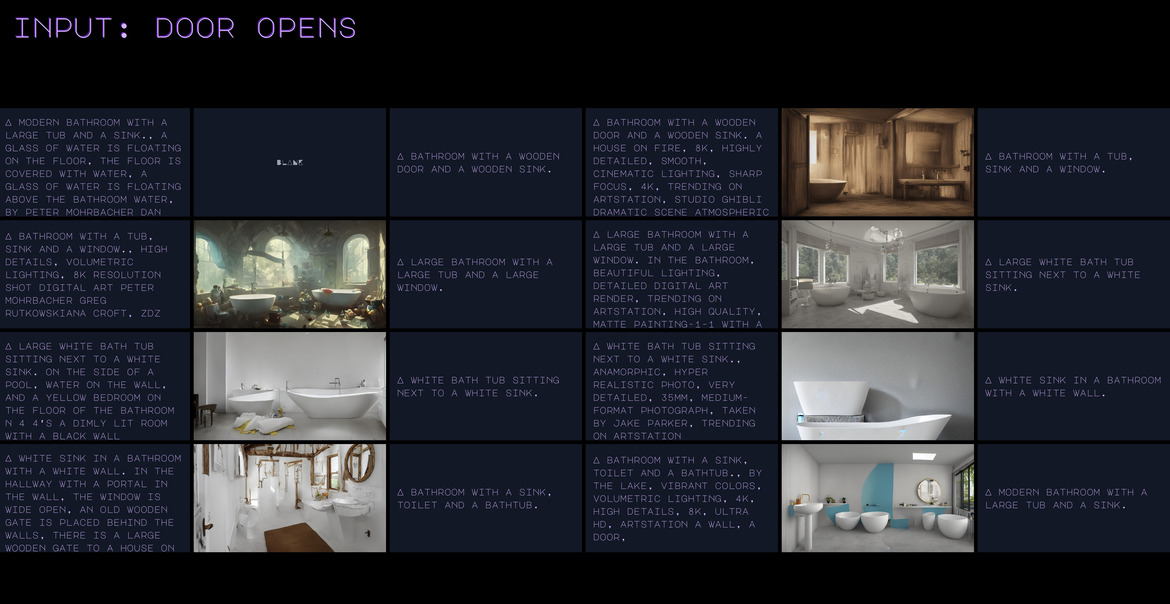
PANIC! — a Playground AI Network for Interactive Creativity — wires generative AI models end-to-end into a feedback loop. Text becomes an image, the image is captioned back into text, and on it goes. You compose the chain, and watch the meaning drift, live, on the gallery wall.
A loop, not a prompt#
We usually meet generative AI one step at a time: a prompt in, an image or a caption out. PANIC! closes the loop instead. It chains models mouth-to-tail — a text-to-image model feeds an image-to-text model feeds the next — so the output of each step becomes the input of the next. The question the installation asks is what the long run of that loop reveals: where meaning drifts, where it settles, and where the models’ biases surface as outputs quietly become inputs.
Composing the chain#
In the gallery you choose which models to string together and set the loop running. The results stream to a set of displays, including a Vestaboard split-flap panel that clacks each new caption into place. Because you build the chain yourself, PANIC! turns a technical curiosity into something you can interrogate directly: swap a model, change the starting prompt, and watch how differently the loop wanders.

Reading the drift#
Run the loop long enough and a question surfaces: amid the apparent chaos, is there structure? A companion paper, Semantic Topologies in the Recursive Application of Generative AI Models (IEEE SMC 2025), uses persistent homology — a tool from topological data analysis — to measure the shape of the loop’s trajectories, putting a rigorous read on the semantic drift the installation makes visible. The Playing Telephone with AI write-up tells that story in full.
Exhibitions#
PANIC! debuted at Creative AI Sydney 2022 (UNSW Art & Design) and featured in the Australian Cybernetic exhibition later that year. It has since travelled to SXSW Sydney 2024 and was peer-selected for the New Interfaces for Musical Expression conference (NIME 2025). It is now a permanent installation in the Cybernetic Studio.
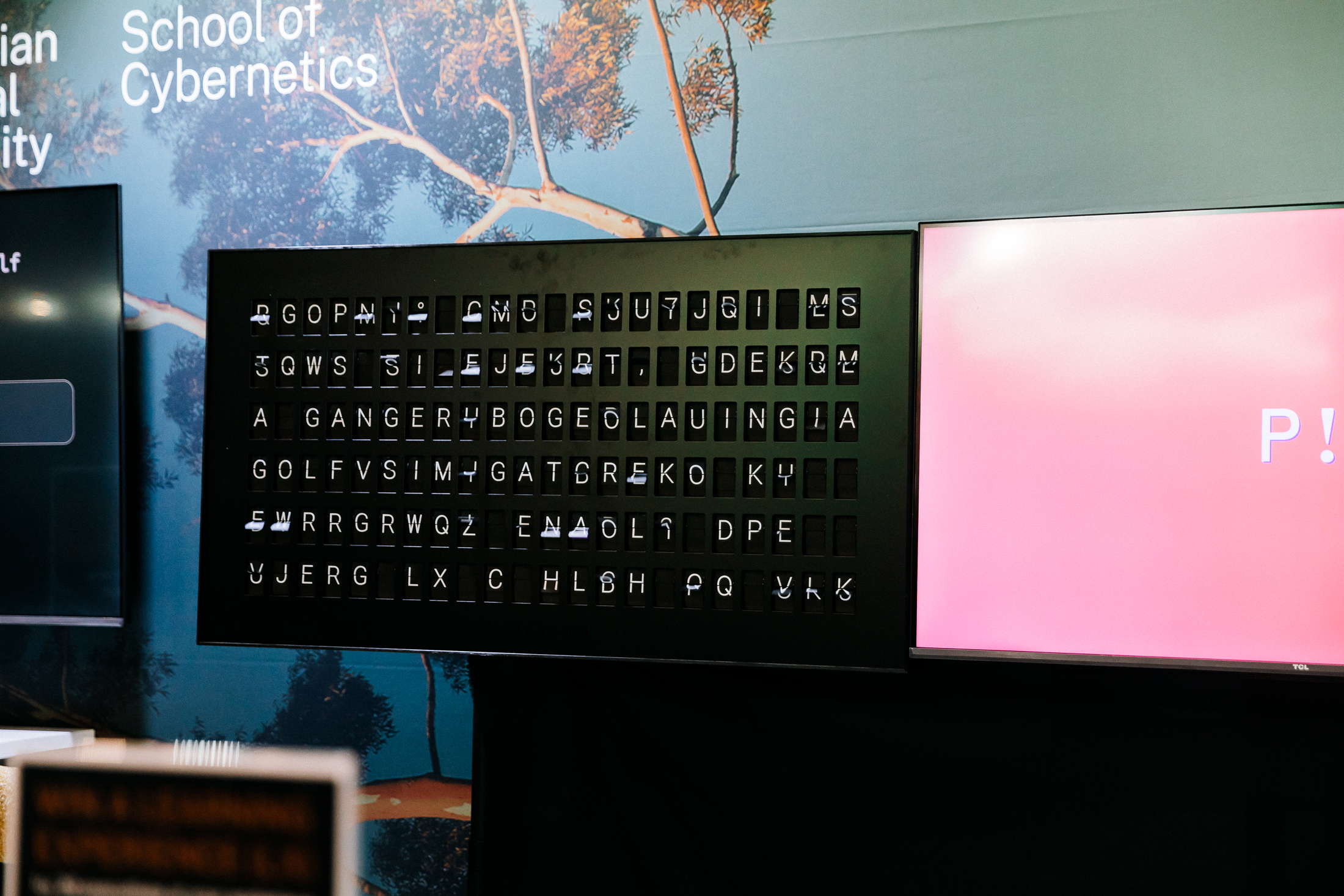
A Cybernetic Studio project by Ben Swift, created with Adrian Schmidt. It began at the Australian Cybernetic exhibition in 2022 — the original write-up explains the cybernetic thinking behind it.
Ben Swift, Adrian Schmidt (2022). PANIC! (a Playground AI Network for Interactive Creativity). doi.org/10.5281/zenodo.17410742 ·MIT
@misc{swiftschmidt2022panic,
  author    = {Ben Swift and Adrian Schmidt},
  title     = {PANIC! (a Playground AI Network for Interactive Creativity)},
  year      = {2022},
  publisher = {Zenodo},
  doi       = {10.5281/zenodo.17410742},
  url       = {https://doi.org/10.5281/zenodo.17410742},
  note      = {Cybernetic Studio, ANU School of Cybernetics}
}
Research metadata
- Category
- Recorded/Rendered Creative Works: Digital (Standard)
- FoR codes
- 460307 Multimodal analysis and synthesis — 50%
- 360503 Digital and electronic media art — 30%
- 460806 Human-computer interaction — 20%
Field of Research (FoR) codes and ERA category are proposed classifications for this non-traditional research output (NTRO), pending sign-off.